-
 The singing woodThe making of the “ddu bottë” in Penna Sant’Andrea
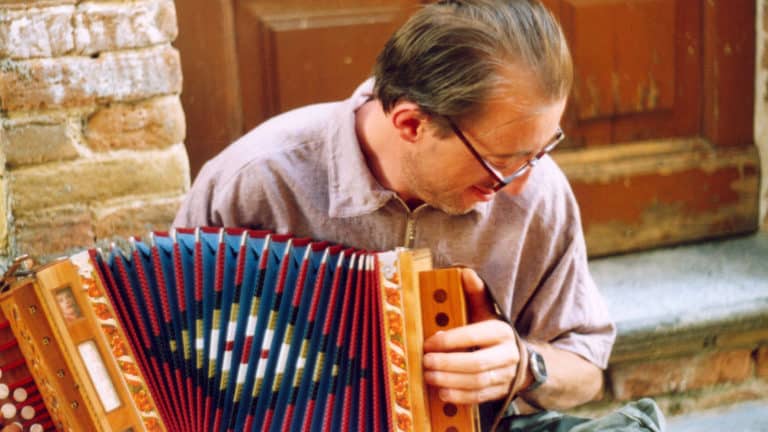
For centuries the Della Noce family has been creating sounds that bring people together through the vibration of metal, first with bells and later with free reed instruments. The sound of the bells fills the air, while the organetto comes to life when the air is pushed through the reed blocks by the movement of the bellows, creating music and making people want to dance. The body of the instrument is made from wood which follows the grain and the sound is produced by buttons, pallets (valves) and springs that open and close the wind passage. Over the years the construction techniques have become more and more refined, adapting to new times and to new requirements, although they have always been grounded on the principles inherited from the founders: attention to detail and creativity.
“The instrument is simple in its structure, but even the most trifling operations, like the gluing and the precision of the holes, are very important. It is the attention to these small details that makes the instrument great. The organetto requires a lot of concentration and passion; nothing can be taken for granted”.
Gianni Falconi, 23 october 2016
The two-bass diatonic accordion, or Italian organetto, known in the Abruzzi area as ddu bbottë, is a mechanical instrument in the free-reed aerophone family of musical instruments, which produces sound through the compression of the air generated by a bellows. The air production is provided by the movement of the player’s arms, so the air is driven across the metal reeds, placed inside the bass housings and the tone chamber, which are opened or closed by the action of fingers on the keyboard.
The organetto is a diatonic instrument, whose sounds are classified according to scales formed by five whole steps (whole tones) and two half steps (semitones) in each octave, with a bisonoric (single-action) keyboard meaning that each button produces two different notes according to the pressing and drawing of the bellows.
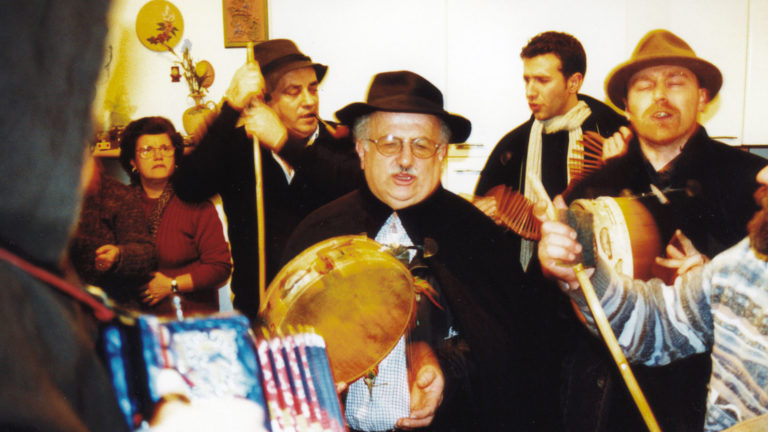
Like with many other musical instruments, the story behind the birth of this exceptionally simple and efficient instrument links the invention of the object to the particular sound it makes in a single legend. In the mid-nineteenth century a farmer from the Marche region, Paolo Soprani, offered hospitality to an Austrian pilgrim returning from the Sanctuary of Loreto. The traveller brought with him an ancestor of the instrument, the accordion. Soprani studied it carefully during the night and succeeded in replicating it, thus giving life to his well-known activity of building handcrafted organettos and accordions. One of the reasons for the circulation of the instrument from the Marche to the Abruzzi region was the devotional element. In fact, pilgrims returning from the Sanctuary of the Holy House of Loreto brought the instrument with them. The circulation was also enhanced by the consolidation of the commercial and professional routes that conveyed goods and skilled labour towards the Abruzzi coast and countryside.
In the province of Teramo, the first artisan workshops arose in the second half of the nineteenth century: Tavani and Janni in Casoli di Atri and in Giulianova, Pistelli in Poggio San Vittorino, Della Noce and Piercecchi in Penna Sant Andrea and Campli during the twentieth century, and finally, Ruggieri, in Nepezzano (suburb of Teramo). The “Della Noce” factory was founded in 1925 by the descendant of an ancient bell founding family, Loreto Della Noce (1896-1988), after returning from his emigration to the United States. Loreto built his ddu bbottë entirely by hand, exploiting the means he had available and creating from time to time the tools he needed to manufacture the individual components: a long evolutionary process renewed by his son Giuseppe Della Noce and his son-in-law Gianni Falconi, who have brought the family organetto into current times.
-
 LISTEN TO THE SONGReeds filing and tuningDuration: 1’27’’’
Savino Iachetti, filing, tuning.
Teramo, 23 October 2016.
Recording by Stefano Saverioni.
Don Nicola Jobbi Study Center Archive/Bambun

- Loreto Della Noce’s ID card, dated 1928, already declaring his professional occupation as “Harmonicas instrument manufacturer” (accordion manufacturer).
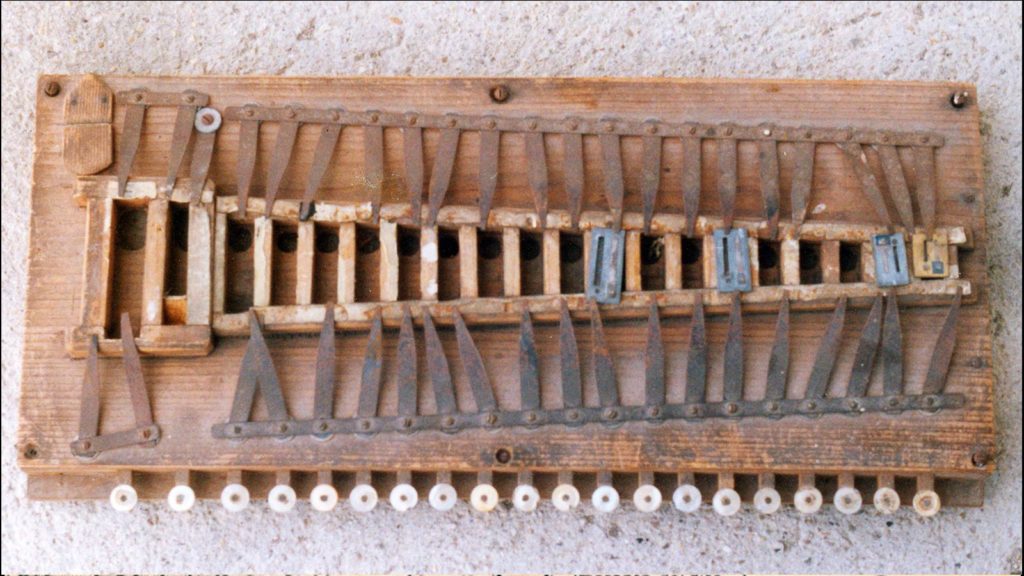
Archivio Della Noce, Penna Sant’Andrea (TE).Harmonicas instrument manufacturerThe singing wood - The old specimen for the tuning of the reeds built by Loreto Della Noce in the first years of activity.
Photo by Gianfranco Spitilli,
Fabbrica “Della Noce”, Teramo, 5 March 2003,
Don Nicola Jobbi Study Center Archive/BambunLoreto’s tuning tableThe singing wood - The fastening of steel reed tongues is secured by nailing on the duralumin plate.
Photo by Gianfranco Spitilli,
Fabbrica “Della Noce”, Teramo, 5 March 2003,
Don Nicola Jobbi Study Center Archive/BambunNailingThe singing wood - The “housing” destined to lodge the reeds of the “tone chamber”; in the centre, the row for the reeds for the bass octave set, which can be operated with the knob that moves the “register” upwards.
Photo by Gianfranco Spitilli,
Fabbrica “Della Noce”, Teramo, 5 March 2003,
Don Nicola Jobbi Study Center Archive/BambunThe “housing” of the “tone chamber”The singing wood - I bottoni dei tasti e i tamponi appena montati; dal loro movimento dipende l’emissione del suono.
Foto di Gianfranco Spitilli, Fabbrica “Della Noce”, Teramo, 5 marzo 2003, Archivio Centro Studi Don Nicola Jobbi/Bambun.Bottoni e tamponiIl legno che canta
WATCH THE VIDEO
The fixing of the reeds
Savino Iachetti fixes the reeds to the reed blocks.
Teramo, 23 October 2016.
Video footage by Stefano Saverioni,
Don Nicola Jobbi Study Center Archive/Bambun.
Teramo, 23 October 2016.
Video footage by Stefano Saverioni,
Don Nicola Jobbi Study Center Archive/Bambun.
Communication and preservation
In recent decades only two of the instrument manufacturing companies – Janni and Della Noce – have remained active, as they were able to convert their production and adapt it to the evolution of techniques and styles, while maintaining their artisanal quality on most of the components: from the creation of the body to that of the reed blocks, the buttons and the valves, from tuning to fixing the reeds with a preparation of beeswax, oil and rosin, from making the bellows to decoration and final assembly.
The “Fabbrica di Organetti Abruzzesi Cav. Della Noce”, moved from Penna Sant’Andrea to Teramo, where it is situated on the hills above the city, and it now serves a national and international market, adapting to the needs of ever more demanding clients who perform in a variety of contexts, from domestic and rural settings to schools, concerts, festivals and competitions.
The company founded by Loreto Della Noce is still strictly family-run and it often features in exhibitions and initiatives to promote the instrument. There is also a museum inside the factory with some precious specimens of organettos produced in the last century, together with handmade equipment used in the past in the various stages of construction, including an ancient reed tuning table, made by the founder in the early years of the workshop.
In the last few decades, the history of the “Della Noce” factory and of the techniques of construction of the organetto, together with other artisan firms in Teramo area, has been at the centre of ethnomusicological and anthropological research, degree theses, photographic books and documentaries, which have helped bring little known aspects to light and disseminate them to a wider audience.
-
 Do you have photos, videos or audio related to this asset?You are welcome to share them with us!Share your knowledge, help us building the inventory! Shall you have direct knowledge and multimedia material about this or other intangible assets, fill the form or contact us!FILL IN THE FORM