The hidden plot
The jargon of the carders from Cerqueto

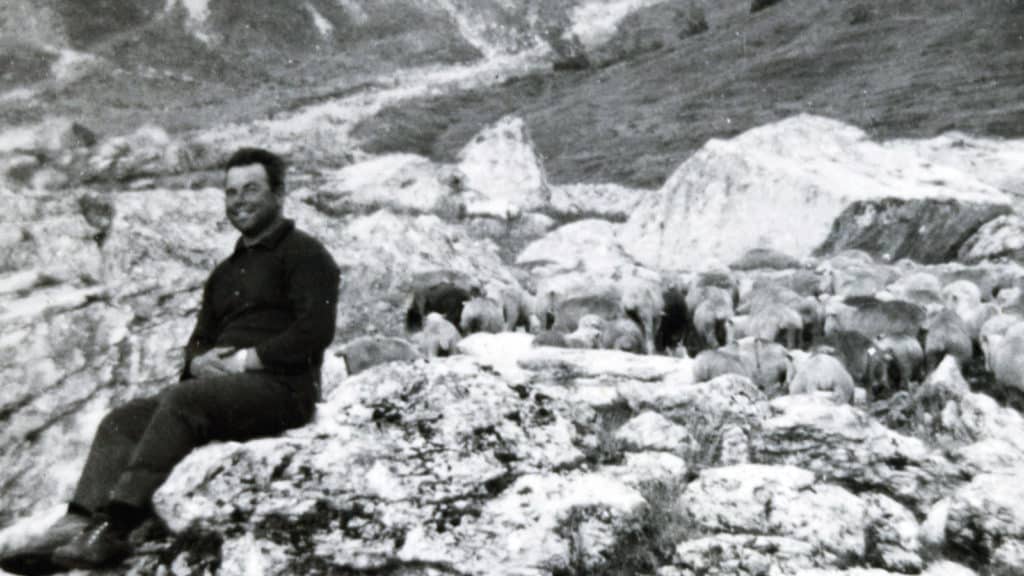
In Fano Adriano, at the foot of the Gran Sasso, the mountain was overrun with sheep from June to September, when the sheep flocks went back to the Roman countryside, guided by shepherds and dogs. Summer was spent on the pastures, in makeshift shelters, made of branches or dry stones, or under the starry sky and the rain; during the winter the shepherds lived in huts made of reeds and straw, or in farmhouses on country estates rented for sheep. In the distance, towards the city, they could hear the Gianicolo cannon resounding at midday.
“In the Roman countryside sheep-farming does not take place throughout the year, but only in that period of time that is significantly favorable thanks to the climate and to the wealth of grass in the natural and artificial pastures in the period from October to May while in the other period the sheep transhumance in the mountains is practiced. Thus, it is explained how both the owners of sheep (armentari) and their employees are often not born in the Roman countryside but come from the whole area of the Central Apennines, and mostly from Abruzzo”.
Romolo Trinchieri, 1953
“Village in Abruzzo Ulteriore in the diocese of Penne, and specifically in the Teramo area, 12 miles away from the city. It is in the district of the Gran Sasso d’Italia mountain, also known as Monte Corno, and is inhabited by 750 individuals, almost all working in sheep-farming “. With these words Lorenzo Giustiniani describes Fano Adriano in the Dizionario geografico-ragionato del Regno di Napoli (Annotated Geographical Dictionary of the Kingdom of Naples) in 1802. Even in the twentieth century sheep, goats, cattle, horses and donkeys populated the mountain of Fano, especially in the summer months when the transhumant livestock went back to the mountains, carrying out the so-called “monticazione (mountain grazing)”, coming from the Ager Romanus or, to a lesser extent, from the Apulian countryside , as it is stated in the rules for the rights to the use of common land of the time (1962). The pasture was divided into two zones, the upper one, destined for transhumant livestock , with the so-called “summer grass “, and the second one, lower down, with the “winter grass “, for the livestock that spent the winter period in the area . The same laws for the use of common land regulated access times, and therefore also the cyclical returns of shepherds and animals: the duration of the pasturage was limited to a period between June 21st and September 29th, and it took place at high altitude locations, such as Monte, Incodaro, Venacquaro, Casetta Leone, Vicenna, Fonte Calzoni and many others, also occupying the nearby mountains, according to the laws of the municipalities that governed the access to adjacent or, in some cases, even distant territories.
The farms in Fano possessed, indeed, tens of thousands of animals , mainly sheep, which they brought to graze in Prati di Tivo, Mount Corvo, Pizzo Intermesoli and Campo Imperatore. On the contrary, the migration system that involved the Papal State and the Patrimony of St Peter provided seasonal grazing for the flocks from Abruzzo in the winter pastures around Rome and in Tuscany and Umbria; the ancient practice, in fact, dates back to an era not long before 1289.
“The mountains were always overrun with livestock, it was the only resource; from here to Leonessa there were only sheep”, recalls Adamo Cortellini, originally from nearby Senarica. It was the only resource for the population but also for the employers, and from the villages of the Upper Vomano many people came to Fano to seek employment with the owners of flocks of sheep like the Nisii, the Riccioni, the Resoluti and the Lancianese Families. Young boys from the hamlet of Cerqueto also came to Fano as there were vacancies for shepherd’s apprentices ; it was a flourishing trade and there was the need for a workforce, there were the big owners and the “muscetti”, who had just a few dozen animals: thousands and thousands of sheep to be taken care of according to the hierarchical organization of the farm businesses and the division of responsibilities and tasks. Sheep breeding, the production of sheep’s milk cheeses, the sale of meat of suckling lamb, from shearing to milking, from marking animals to periodic checks on the state of health of the livestock , everything had to be regulated by the boss of the farm business, the vergaro, with his organized staff : the pecorari who worked on the pasture and were responsible for looking after the flocks , the caciere or caciaro, specialized in the production of cheese, the buttero, in charge of taking the suckling lambs, ricotta, cheese and other products to be sold in Rome, the bagaglioni, responsible for transporting wood with the beasts of burden and procuring everything that could be useful for the working of the farm, and finally the biscini, shepherd’s apprentice boys engaged in minor tasks, such as bringing water and moving the fences .
June 29th was the feast of Saints Peter and Paul, to whom the mother church of the village is dedicated. In Fano Adriano it was also the day of the livestock fair and summer in the mountains began. In mid-September it was time to start thinking about the transhumance, the long journey together with the animals, and the various stages for daily stops. After about eight days of walking, the descent from the mountain pastures was accomplished, with the return to the Roman countryside or, with an even more demanding transhumant route, to the Apulian lands. In the Roman farmlands, when the shepherds did not have a farmstead in which they could take shelter, they built huts made of straw, reeds and wooden poles, where they spent the whole period away from home . Bruno Riccioni remembers the big hut, where the sheep farmers without a family slept and made cheese and ricotta or cooked over a fire placed in the centre of the building, among a few bricks of tuff. A little pasta, a little sauce and a little bread had to suffice.


Sheep shearing in the farmstead of Luigi Riccioni at Pallavicina.
San Cesareo (RM), 1950s .
Footage by Leonardo Riccioni,
Riccioni Fund, “Melchiorre Dèlfico” Library/ Don Nicola Jobbi Study Centre.
After several crises throughout the course of the twentieth century, which coincided with periods of intense emigration from the mountain areas to Canada, the United States, Venezuela, or the more developed areas of Europe, in particular after the Second World War, the practice of transhumant sheep farming in the way it was transmitted for centuries between Abruzzo and the Roman and Apulian plains, has largely been abandoned. Few farms remain today, and they have generally become settled in one place either operating in the mountains throughout the year or, more frequently, basing their activity in Rome and taking only a small part of their livestock to the summer pastures.
With the progressive affirmation of industrial production some particularly significant processes linked to the sheep-farming sector, such as wool production, have practically fallen into disuse, and have only recently received renewed attention thanks to restoration projects supported by the National Park of Gran Sasso and Monti della Laga. The problems which have arisen as a result of the new presence of predators, such as wolves, reintroduced in recent years, have further discouraged the practice of breeding on site, and led to the widespread abandonment of traditional pastoralism.
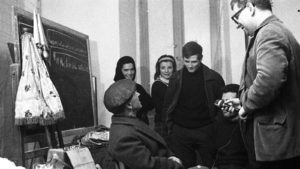
In documenting this overall impoverishment of the pastoral culture, an especially important role has been played by a video made on 8mm film by Leonardo Riccioni in the early 1950s , when the transhumance on foot was still practiced, accompanied by all the activities that were involved in the life of the shepherds, from the slaughter of the lambs to the shearing, carried out at the Pallavicina farmstead by the carosini from the Apulian region, today replaced by those from New Zealand. Photo archives kept at the homes of prominent Fano families have also played a significant role, as they portray an era that has rarely been the subject of research conducted on the territory, apart from the study masterfully carried out by the Japanese social anthropologist Yutaka Tani at the end of the 1960s, which focused on sheep-farming in the village of Cerqueto.
Today, there are some fairs that seek to keep the sector alive, such as the Fonte Vetica fair at Campo Imperatore, and the one at Piano Roseto; or initiatives of museums, like that of the Ethnographic Museum of Cerqueto, which collects and preserves a number of objects from the local pastoral culture and organizes events related to the promotion of productive activities and of the cultural heritage of pastoralism, like those organised in Fano Adriano thanks to the “Pro-loco”, “Grignetti” and “Fano Friends of the Crib” associations. In this way, the processing of cheese and ricotta, and the preparation of some dishes of pastoral origins, such as the so-called mutton “alla callara”, or the grilled mutton and lamb, made with local meat and eaten at home , or in restaurants , appear to have been handed down over time. On the contrary, few traces of intangible goods remain, and only in the memory of the elderly.


The jargon of the carders from Cerqueto
The Living Nativity Scene at Cerqueto
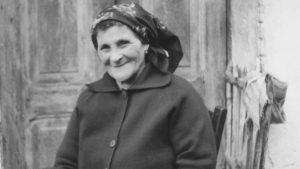
The vatocco song in Cerqueto
© 2018 All rights reserved