
The jargon of Pietracamela carders

The secret word
The jargon of Pietracamela carders

An evocative and unusual way of singing, with a characteristic pattern of many voices, echoes in the memories of the inhabitants of Pietracamela who heard or performed it a long time ago, and in the invaluable recordings that captured for posterity the style, the words and the vocal intensity of the singers. With a loving or mischievous canto a dispetto style (the song of the despised), or adapted to the religious occasions of the life of the community, the folk songs or ditties were a powerful means of communication among teams of people who worked in the fields, for courtship and challenge, for adoration and greeting to the newborn Holy Child in the cold stable of Bethlehem.
“Je tinghë na saletë da mannà a gl’bambëneglië / je vuglie fa jejë / da mannà a gl’bambëneglië
je vuglie fa jejë”.
“I’m sending a warm greeting to baby Jesus/ I want it to be sent/send it to baby Jesus, I want it to be sent.”
Stornello for Baby Jesus, 1964
In the earliest years of his stay in the mountains as the parish priest of Cerqueto, Don Nicola Jobbi had the opportunity to attend the parish church of the nearby community of Pietracamela, a village at 1005 metres of altitude at the foot of the Gran Sasso mountain. On the occasion of masses during the Christmas period Jobbi heard for the first time the Pretaroli (the inhabitants from Pietracamela) songs for Christmas and he immediately organized recording sessions in which he documented the original dialect and polyphonic repertoire which later attracted the attention of many researchers. The meetings took place in particular with a group of women who frequented the church, among whom emerged the figure of the Ginevra Bartolomei, known by everyone as La Gina or Emidiola, whom Jobbi focused on in the subsequent documentation.
Jobbi’s recordings in Pietracamela took place between the end of 1964 and the winter of 1966, perhaps in circumstances relating to the preparation of the first Living Nativity scene – performed in Cerqueto but originally scheduled in Pietracamela-, for which they were then used as part of the soundtrack; in the following years, the ethnographer priest, continued his research when he also became the Pietracamela parish priest, with more documentation up to the winter of 1983.
In Pietracamela this kind of polyphonic repertoire, often performed in the canto a dispetto style (the song of the despised), was sung to alleviate the fatigue, or to transmit information from one field to another about the evening appointments and the venues of parties and farmyard dances, but also to date and even to argue in a ritualized way which was controlled by means of the verse, the irony, and the extemporaneousness of the message; or for good wishes and weddings. However, the women also sang to solemnize religious occasions, when they gathered in church and their choral singing reverberated around the nave. The need to cover large distances formed powerful and penetrating voices, and the constant practice favoured the maturation of awareness about the quality of the voices themselves and of the roles to be assumed during performance. Only a few women were able to sing the opening notes of the sequence and then lead the rest of the choir with wisdom and competence for the entire duration of the stornelli (folk songs).
The Pietracamela polyphonic songs are, in fact, opened by a solo voice, followed by a choral part in unison and then by a rapid separation of the voices according to the sequence 3° 3° 5° 5° 3° and unison in the final cadence, as reported by the ethnomusicologist Roberto Leydi, who started studying them in the early 1960s.
One of the most popular interpretative methods of polyphonic stornelli in the town was the greeting dedicated to the birth of Jesus and to the Holy Family, which Jobbi himself called the Stornelli to the Baby Jesus. The form of polyvocality – common to both the canto a dispetto style (the song of the despised) and the courtship songs – is comparable to a type attested in a wide area of central-eastern Italy, even if it is not documented in the other areas of the Gran Sasso and of the region as a whole. Roberto Leydi suggests, in reference to this type of harmonic structure, a comparison with similar models found in the communities from the Istria and Veneto areas in north-east Italy and from Croatia on the other side of the Adriatic.


Luigina Panza performs some stornelli dedicated to love.
Pietracamela (TE), August 17 2012.
Footage by Marta Iannetti, Don Nicola Jobbi Study Centre Archive/Bambun
The singing is currently almost extinct, after the death of the last elderly people able to perform it with its concatenation, its original improvised forms and a vocality that is specific to this kind of repertoire. Pietracamela is the only place in the whole of the Gran Sasso and Monti della Laga area where there is evidence of the type of polyphonic song documented by Don Nicola Jobbi in 1964, and later by many researchers, among others, Maurizio Anselmi and Giuliana Fugazzotto in the 1980s. Here, the particular arrangement of the melodic lines was enhanced by the use of an original dialect which is difficult to understand and which has also been undermined by the depopulation of the town and by the lack of a real inter-generational transmission.
Don Jobbi has documented several variants of these songs, recording both the different text types for different occasions (dedicated to love or in the canto a dispetto style or for religious purposes), and also the refined harmonic micro-variations, essentially belonging to two prevailing models.
The recording made along with Maurizio Anselmi in 1983 was later published and documented in Teramano, the third volume of the Documents of the Abruzzo region, dedicated to the Alto Vomano and the Laga Mountains. The same recording has subsequently been disseminated, together with the other sound materials recorded that day in the church of San Leucio in Pietracamela, on the initiative of the Archivio Sonoro Abruzzo (Abruzzo Sound Archive) project; versions of the Pretarolo polyphonic song recorded by Don Jobbi twenty years before have also been disclosed on the portal.
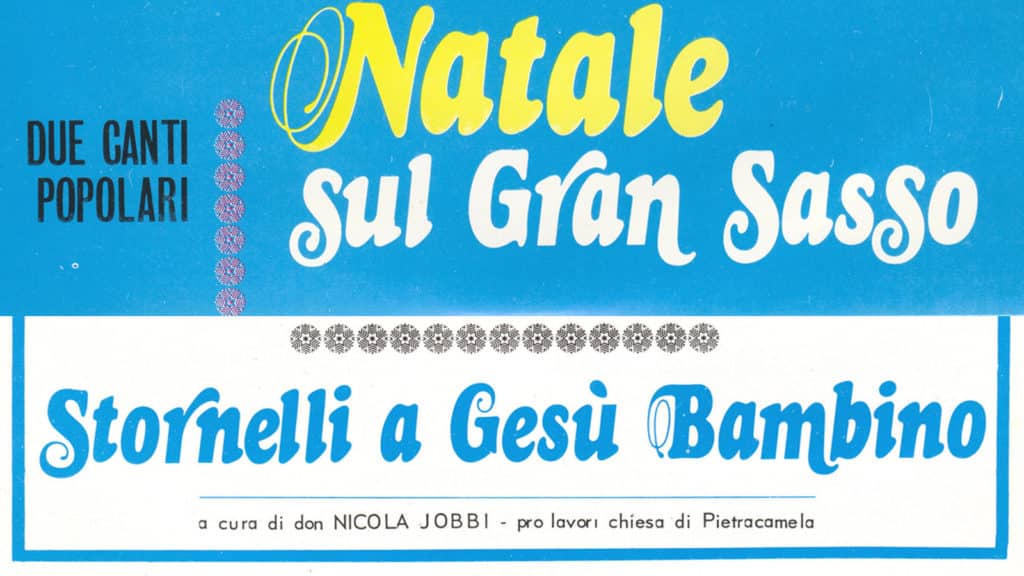
However, the first publishing initiative remains Jobbi’s work at the end of the Seventies, when he released a 45-rpm vinyl in order to finance the restoration of the church of Pietracamela, using their recordings of the early Sixties.
In the last few years digital copies have been made and original materials have been restored with a view to their unabridged publication in the framework of the project of study, recovery and dissemination run by the Jobbi Fund of the Bambun Cultural Association, and the Don Nicola Jobbi Study Centre with the participation of numerous national and international territorial and scientific institutions. The first person to undertake a systematic recovery of the original tapes, their duplication and a preliminary filing, at the request of Roberto Leydi, was Soriana Martegiani at the end of the Eighties during the preparation of her thesis at the DAMS Department of Drama, Art and Music Studies at Bologna University.


© 2018 All rights reserved