-
 Happy funeralThe Dead Carnival in Montorio al Vomano
Devils and friars, widow and lovers, children and gravediggers, led by a histrionic Archpriest, escort the deceased Carnival on his last journey through the streets of the town. After a bizarre prayer vigil, the Dead Carnival, lying in his coffin with a white face and with a flower between his legs, is transported in a funeral procession accompanied by a cacophony of wails and laments and the ironic or solemn sound of the marching band. Suddenly he sits up, makes a sign of the horns hand gesture and lies back down on the casket lining, clutching in his hands a rosary and a horseshoe. In the central square, among moments of comic mockery by improvised actors gathered along the procession route, the grotesque funeral is celebrated in a symbolic final death.
Funeral announcement, February 2018
The Dead Carnival of Montorio al Vomano, a densely populated village located in a hilly area near the River Vomano, at the foot of the mountain, is a ritual action that celebrates the end of the carnival – and his death rendered in a satirical form – on Ash Wednesday, already during the time of Lent. The community participates in the funeral ceremony, which opens with the prayer vigil and concludes with the solemn funeral rites on a stage set up in the main square of the village, enacted by local people and today coordinated by artistic director and actor, Vincenzo Macedone.
The desperate widow, the Archpriest and the band mark the stages of the ritual; in the coffin the Dead Carnival is embodied by a real person, the object of derision and mocking dialogues improvised on the spot, linked to the events which occurred during the year but freely expressed and organized by those who participate in the performance.
The Dead Carnival is the result of a long evolution which began in the second half of the sixteenth century, with the emergence of the Reformation and the Counter-Reformation and the intensive attempt to abolish, contain or modify some particularly obscene and subversive dramatizations and festive events. Rituals that celebrate the death of Carnival can be found all over Europe, as demonstrated by the extensive research conducted by the anthropologist John Kezich and his team in the last decade. Court trials, death penalties and funerals, funeral pantomimes and burnt effigies are also widespread in Italy and always follow the great celebrations and dances on the canonical days of Sunday, Monday and Shrove Tuesday.
At Reggello, in the Arno Valley in Tuscany, at Marroneto, in the province of Grosseto, at Amalfi, in the gulf of Salerno, the Dead Carnival was or is embodied by a person chosen among the inhabitants of the village, according to an omnipresent pattern in the central and southern regions of the peninsula. There were frequent ritual substitutions of the performer in flesh and bones with a rag and straw effigy, made during the course of the conviction and symbolic funeral at the time of execution of the judgment. In Intermesoli, not far from Montorio al Vomano, the Carnival was impersonated by one of the villagers who was tried and condemned, force-fed until he felt ill, then replaced by an effigy and burned.
The origins of the Montorio ritual, according to the uncertain testimonies gathered in situ are to be found in the 1920s, when a group of local university students enrolled at the University of Naples copied the tradition after having observed it in some villages in the Campania region, in opposition to the fascist regime that would forbid it a few years later. The Dead Carnival, impersonated by an effigy, used to be transported around the village in a coffin; at the end of the procession it was thrown into the River Vomano, near the small church of Madonna del Ponte. It is not clear when the effigy was replaced by a living person, or if the two elements, as frequently reported elsewhere, were both present at the same time and only the custom of the effigy has fallen into disuse.
The funeral dramatization brings out into the open both social criticism and the ritual breakdown of established authorities and of social conventions. At the end of the evening, after returning to the place of departure, the procession is dissolved; the carnival is declared buried and Lent, represented by the surviving widow, confirms its triumph by introducing the community to the Easter time of renunciation and of abstention.
-
 LISTEN TO THE TRACKThe sounds of the funeral processionDuration: 3’12’’’
Montorio al Vomano marching band; screaming and wailing
Montorio al Vomano (TE), 14 February 2018.
Recording by Marta Iannetti,
Don Nicola Jobbi Study Center Archive/Bambun.

- The protagonists of the procession of the Dead Carnival posing in piazza Orsini.
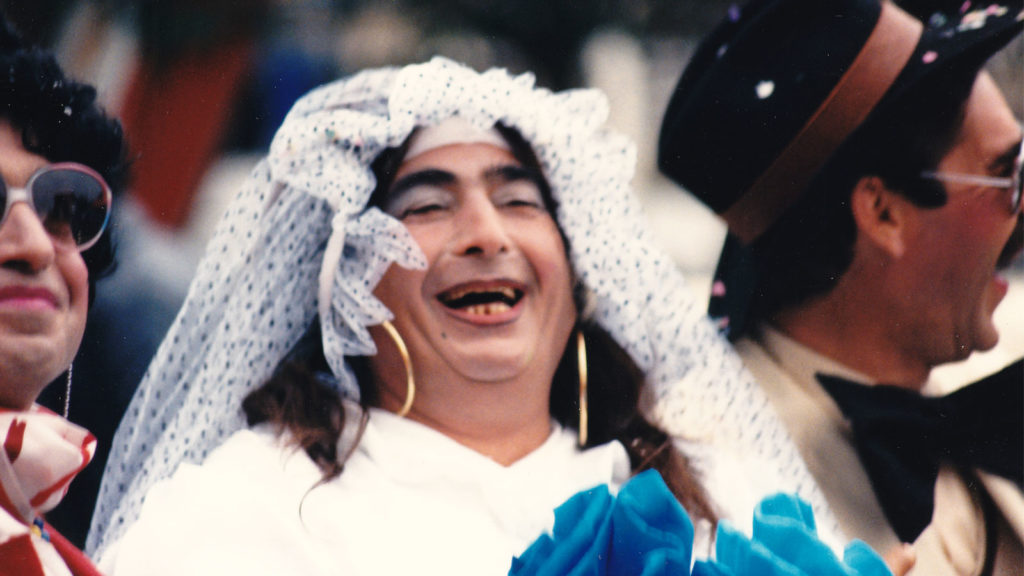
Photo by Flavio Paolini, Montorio al Vomano (TE), 1975 ca., Montorio Photographic Archive.The Dead Carnival in piazza OrsiniHappy funeral - Alfredo Tertulliani known as “Turturillë”, a key figure of the Montorio Carnival in the last thirty years of the twentieth century.
Photo by Sergio Rossi, Montorio al Vomano (TE), 1988, Montorio Photographic ArchiveTurturillëAllegro funerale - Vincenzo Macedone in the role of the archpriest putting make up on the Dead Carnival before the start of the funeral procession.
Photo by Stefano Saverioni, Montorio al Vomano (TE), 14 February 2018, Don Nicola Jobbi Study Center Archive/Bambun.PreparationsAllegro funerale - The group of hooded-hermits carrying the Dead Carnival in procession.
Photo by Stefano Saverioni, Montorio al Vomano (TE), 14 February 2018, Don Nicola Jobbi Study Center Archive/Bambun.CarriersAllegro funerale - Luigi D’Agostino, in the role of the Dead Carnival, in procession in the coffin.
Photo by Stefano Saverioni, Montorio al Vomano (TE), 14 February 2018, Don Nicola Jobbi Study Center Archive/Bambun.In the coffinHappy funeral
WATCH THE VIDEO
The Deposition
In an atmosphere of general laughter and sarcasm the Dead Carnival is laid in the coffin while the cast put on make-up in preparation for the funeral procession.
Montorio al Vomano (TE), 14 February 2018.
Filming by Stefano Saverioni,
Don Nicola Jobbi Study Centre Archive /Bambun.
Cultural Transmission and preservation
The Dead Carnival is organized by the Pro Loco association, together with the Carnival Association which is responsible for bringing back the Montorio Carnival in 1988 after thirteen years of interruption. This revival, and then expansion of the event, was made possible thanks to the commitment of some people – among them Gianni Celli and Alfredo Tertulliani, known as “Turturillë” -, who took over the organization of the parade of floats and the Procession of the Dead Carnival.
Over the years, the practice of satirical procession has met hostility and been subject to legal actions, which were the main cause of the suspension of the event which occurred in 1975, when some people from Montorio brought the Dead Carnival to trial in Teramo for contempt of the state religion. Charges had also been brought in the village in former decades, causing repeated abolition of the satires in dialect and in rhyme with which the protagonists made fun of the life of the community, targeting people and events of the past year. Since the beginning of the new century, the stage actor from Montorio, Vincenzo Macedone, has been the artistic director of the whole event, protagonist of the procession of the Dead Carnival in the role of the archpriest and coordinator of the whole satirical cortege.
The procession was also the subject of a ministerial cataloguing under the BDI scheme (Intangible Demoethnoanthropological Assets), promoted by the region of Abruzzi and conducted by the anthropologist Lia Giancristofaro in 2010.
While maintaining many significant structural elements and encouraging the collaboration between the organizers and the community, the Procession of the Dead Carnival has over time lost some important traits which have sunk into oblivion, such as the use of effigies, or the most vivid dynamism of the satirical scenes, today mostly confined to the celebration of a burlesque funeral on a stage placed in the square and limited by the use of microphones. However, the spontaneity of improvisation remains unchanged and, sometimes favoured by the presence of actors such as Macedone, who manages the performance with skill, and it seems to be a particularly deep-rooted quality transmitted in the Montorio population and in some of its protagonists.
-
 Do you have photos, videos or audio related to this asset?You are welcome to share them with us!Share your knowledge, help us building the inventory! Shall you have direct knowledge and multimedia material about this or other intangible assets, fill the form or contact us!FILL IN THE FORM