-
 Pass the card or keep it?The game of Stù in Montorio al Vomano
Of ancient origins and still surviving in just a few areas of Europe, the game of Cucù (Cuckoo), known in Montorio al Vomano with the name of Stù, involves the whole village in exciting tournaments and matches over the Christmas period in the houses and in the bars, restaurants and taverns, accompanied by mockery, jokes and laughter, on big tables with many players surrounded by people. The cards make their way around the table, getting swapped or blocked or coming back to where they started from according to the moves and their sequences. One round after the other, the players decrease in number up to the final duel, which will decide the winner of the table and the match.
“When one wishes to play the aforementioned game, all those who wish to play put the set coin in a dish and everyone takes an assigned number of cards, which should be agreed. Then all the cards are taken back and one is given to each of the players, and each of the card players should exchange it with the one next to him, while there is no obstacle, just once in the same round as in a relay race”.
Raffaello Bisteghi, 1753
The dialectal name of Stù in use in Montorio al Vomano is probably derived from “Sto” (I’ll stay, or I’ll keep my card), the word used in the dynamics of the game in opposition to “passo” (I’ll pass the card),when you decide to keep your card instead of trying to replace it with your neighbour’s.
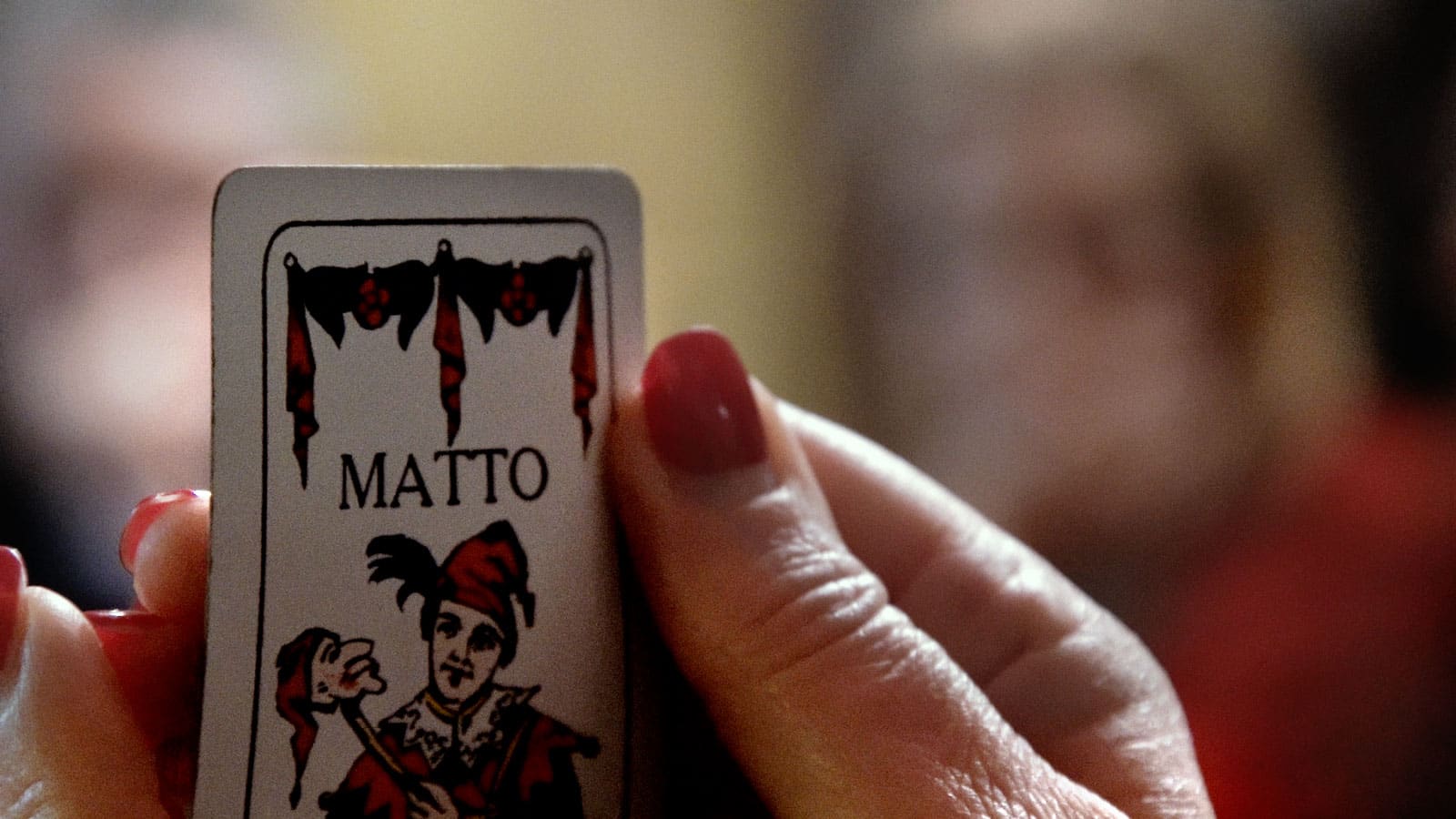
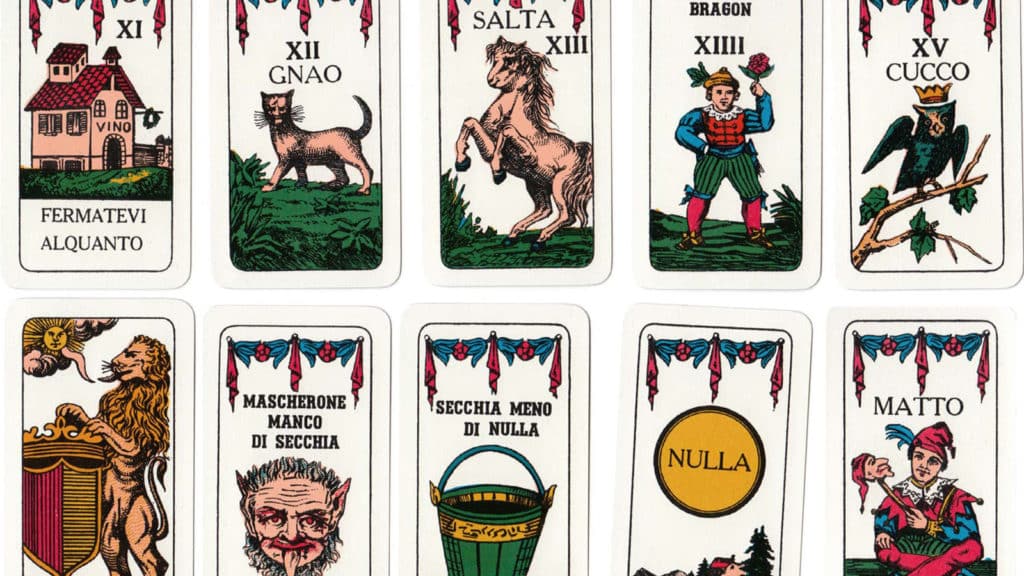
In its known variants in the Abruzzo region (in Montorio al Vomano and in Campli, where it is called Cucù or Ttuffë), it is therefore an exchange game and not a trick-taking game , whose deck is composed of forty cards, divided into two sets of numbered cards and picture cards.. The picture cards are organized into two “formations”, either below or above the ten numbered cards, which represent the intermediate values: the five cards below the numbered cards have increasing value and include the Fool that is a negative card, but of a variable value; the last five include several figures, called “triumphs”, which oblige players to perform actions or pay forfeits.
According to Nicolino Farina, who has carried out a detailed study of the game, Cuckoo was originally played with dice, tiles and other similar objects, identifying a direct antecedent in a seventeenth century engraving which belongs to a collection of Jesuit manuscripts kept at the Central National Library of Rome. It is a sheet depicting nineteen circles with identical numerical and pictorial representations to those of the Cuckoo game, which were cut out and placed under the pawns. The evolution towards a real deck of cards seems to have occurred in Italy, in the Emilia Romagna area, spreading rapidly throughout Europe from the sixteenth century onwards and reaching its maximum expansion in the eighteenth century.
In the Statutes of Bologna of 1245-1267 there is a mention of a game called Gnaffus, which recalls the name of a card known as Gnaf in the Stù game from Montorio; the oldest known set of rules of the Cucco game also appeared in Bologna in 1717 although there were different types of decks of cards in the course of the nineteenth century. Moreover, it is interesting to hypothesize a similarity between the Cuckoo game and the Trionfi (Triumphs) card games, also known as the Venti figure (Twenty figures), found in Naples, together with the Tarocchi (Tarot) and the Malcontento (Discontent) between 1585 and 1586, when they are listed among the popular games with an ambivalent divinatory function, as suggested by the scholar Giuseppe Ierace.
Farina argues that the game was introduced to the Teramo area between the seventeenth and eighteenth centuries, by the Farnese family in Campli and by Count Carafa, a very influential member of the Neapolitan court, in Montorio,.
Particularly well known in Northern Italy and in Northern Europe, the game was played not only in Bologna, but also in Milan and, more generally, in Lombardy, in Piedmont, towards Venice, perhaps in Rome and in Tuscany, and certainly in Bari where there was a card maker who printed specimens of the game at the beginning of the twentieth century,. There are also significant traces in Spain (Cuco), in Catalonia and in the Balearic islands (Cuc), in France (Coucocu), in Belgium, and in the Netherlands (Koekoek); as a deck of thirty-eight cards in Bavaria and in Austria the Cucco has become the game of the witch (Hexenspiel), or of the bird (Vogelspiel), while in Sweden, in 1741, it is found with an Italian name, Cambio (exchange), later referred to as the Kille; in Denmark it was Gniao or Gnav, and as such it was exported to Norway and finally spread to Finland (Kucku). In some areas of Europe, such as the Danish islands Fionia and Sjælland, or in the Dutch Zeeland, the game is still practiced in a variant with pawns, and it is increasingly rarely played in Scandinavia and in some of the Bergamo valleys.
The first dealer, chosen by extracting a card, shuffles the deck, gets the player on his left to cut it , gives a card to the first player on his right, and waits for his decision. If the player decides to keep the card he says “sto” (I’ll stay), while if he thinks he needs to pass it on he says “passo” (I’ll pass it on), and the card is passed on to the next player, who will then make a decision. When the previous player has chosen to pass the card on, the next one will have to forcefully exchange his card, unless he has a “triumph”, a card with a value greater than or equal to eleven.
The game carrying social and symbolic metaphors is described effectively by Saverio Franchi – who has dedicated a paper to the Stù of Montorio and to the card game of the Cucù in general – as the representation of human society (the table of players), of social roles and of fate (one’s own card), and of the possibility to change both, either improving or worsening one’s own destiny (by changing the card), but having as a limit the confrontation with the mighty (the “triumphs”, the highest figurative cards) and the risk of falling into misfortune (the lowest figures) or coming across the unpredictable Fools which it is always better to steer clear of, although in exceptional cases the game may save and reward them (if the two Fools remain, they win).
Moreover, there is always the possibility that the lords of the game are brought down by the crowned owl dominating the darkness and the uncertainties, the highest card: the Cuckoo
-
 LISTEN TO THE TRACKMetaphor of lifeDurata: 1’18’’’
Sabatino Mazza, voice.
Montorio al Vomano (TE), February 15, 2018.
Recording by Marta Iannetti,
Don Nicola Jobbi Study Centre Archive /Bambun.

- The card of the Fool during a tournament match.
Photo by Stefano Saverioni,
Montorio al Vomano (TE), January 6, 2018,
Don Nicola Jobbi Study Centre Archive /Bambun.The FoolPass the card or keep it? - Final of the Stù Christmas tournament at the Tittina Motel.
Photo by Stefano Saverioni,
Montorio al Vomano (TE), January 6, 2018,
Don Nicola Jobbi Study Centre Archive /Bambun.The final matchPass the card or keep it? - The traditional Bergamasque cards used in Montorio, in the past published by Masenghini and later taken over by Dal Negro.
Photo by Stefano Saverioni,
Montorio al Vomano (TE), February 14, 2018,
Don Nicola Jobbi Study Centre Archive /Bambun.The cardsPass the card or keep it? - A player chooses his move during the final stages of the Stù Christmas tournament.
Photo by Stefano Saverioni,
Montorio al Vomano (TE), January 6, 2018,
Don Nicola Jobbi Study Centre Archive /Bambun.The choicePass the card or keep it? - A player “reads” his card during the final stages of the Stù Christmas tournament.
Photo by Stefano Saverioni,
Montorio al Vomano (TE), January 6, 2018,
Don Nicola Jobbi Study Centre Archive /Bambun.“Reading”Pass the card or keep it?
WATCH THE VIDEO
The match
In an atmosphere of hilarity and friendly tension, some enthusiastic card players from Montorio play a game of Stù in a wine cellar in the village.
Montorio al Vomano (TE), February 15, 2018.
Filming by Stefano Saverioni,
Don Nicola Jobbi Study Centre Archive /Bambun..
Transmission and Conservation
The “Great Stù tournament”, which takes place every year during the Christmas period, has been organized for a decade by the “Il Colle e il Solleone” Cultural Association. The event, born with the desire to promote and enhance the game within the community of Montorio itself , thus also promoting its transmission and the participation of young generations, involves the town and numerous surrounding hamlets during the qualifying rounds, which extend over a period of about a month. It is an initiative of great and growing success, which brings together hundreds of people, both players and spectators, always present in large numbers to watch the exciting games. It is, indeed, thanks to this initiative that the town has been able to protect the game and the very means that are necessary to ensure its continuation: the cards. A few years ago, in fact, the only Italian company that prints them had decided to interrupt their production due to the small number of buyers; the commitment of the town of Montorio to guarantee a continuity of purchase through the Cultural Association “XV del Presidente”, which at the time took care of the organization of the first tournaments, allowed the resumption of the printing of the cards ensuring a future for the Stù game. In the same years, when organizing the tournament, the regulations were codified, by transcribing the rules of the game which had previously been transmitted orally through practice; the first rule summarizes the meaning of the game and highlights the value it takes for the community that participates in it: “The aim of the game is to have fun together with friends in the hilarious and joyful atmosphere that is created “. Moreover, the sums of money collected during the tournament are donated to charity each year.
A permanent exhibition by the artist Mauro Capitani, housed in the rooms of the former convent above the Chiostro degli Zoccolanti, is also dedicated to the game of the Stù and over the years research has been carried out and publications have been written that study in deep the history and symbolism underlying the original game, including that of Saverio Franchi of 1991 and the subsequent one, published in 1997 by Nicolino Farina, dedicated in particular to the Camplese and Montoriese versions of Cucù,.
In recent years, the Stù game has represented the Abruzzo Region at “Tocatì”, the International Festival of Street Games in Verona; in 2015 the same association that takes care of the organization of the Festival published a volume on the traditional games of Italy, including in the book some pages and images of description and analysis of the game from Montorio.
A website dedicated to the Stù game, constantly updated and rich in materials and documents, tells the story of the game’s history and current developments http://www.stuinpiazza.it.
-
 Do you have photos, videos or audio related to this asset?You are welcome to share them with us!Share your knowledge, help us building the inventory! Shall you have direct knowledge and multimedia material about this or other intangible assets, fill the form or contact us!FILL IN THE FORM