-
 The art of the loomHand-weaving in Campotosto
The time for hand-weaving is not yet over in the mountainous area of the Central Apennines. In Campotosto, a town nestled in the Upper Aterno Valley, on the shores of the lake of the same name, Assunta Perilli was passionately inspired to learn the art of frame-loom weaving from the elderly local weavers before the oral transmission of knowledge was completely interrupted.
By studying the origins of this ancient art, she has rediscovered its functions and techniques and has begun to experiment with new ideas. Her studio is a permanent safe haven among the rubble of the earthquake and in a landscape deeply affected by the seismic activity, the rhythmic sound of the frame loom accompanies her as she works, together with the movements and the knowledge that bring it to life every day.
“Having seen the frame loom, the desire to get it working again was immediate…love at first sight that has grown into a great passion. It is a love that is always renewed, every time you decide to weave cloth; I think that these “grandmothers” have transmitted it to me, because I have learnt all of this art through the oral tradition but also their “modus vivendi”. I assimilated this mixture of knowledge and at a certain point I felt like I was ninety years old just like them.”
Assunta Perilli, July 27, 2018
In the inland areas of the Laga Mountains, in the towns and villages that are among the highest in the Central Apennines, domestic production used to be essential for survival. In Campotosto, at 1,420 metres of altitude, frame loom weaving and the production chains linked to the processing of plant and animal fibres, from linen, hemp and wool, constituted a complex process in which the knowledge and practices developed over thousands of years converged. From the field to the pasture, from the harvesting to the shearing, from the complex procedures of maceration, drying, separation of the fibres from the woody part to the flax and hemp combing, from the carding of the wool to the spinning in the autumn and the natural dyeing, the production of textile fibres reached the frame loom, a rudimental but ingenious mechanical structure , on which the threads were woven into their final form . Clothes, blankets, pillowcases, sheets, tablecloths, towels and every other kind of fabric took shape thanks to the patient work of the weavers, with decorations and iconographic motifs that depended on personal tastes, on the function of the cloth and on the raw materials available for the choice of colours and combinations.
All of these production chains come together today in Assunta Perilli’s weaving studio thanks to a network of partnerships built up over the years between the farmers, breeders, carders, spinners and weavers from the mountainous areas of Gran Sasso and Laga. This ten year journey of discovery began when Assunta came across a frame loom and a family history of practices and purely feminine knowledge, which was at the time silent and inactive, waiting like a slender thread resistant to the passing of time until she was willing to bring it back to life again, despite the apparent loss of the reasons for its original use. Found in a storehouse, the old wooden frame loom which once belonged to her grandmother, Assunta Onofri, thus came back to life in her hands after being abandoned for a few decades. Ms Perilli was helped in this endeavour by the last remaining weavers of the town ,whose trust she gradually earned after their initial disapproval of her decision, to bring back an activity which no longer made sense to them. Maria Dea Vertolli also known as “Idea” and Domenica Quintiliani known as “Mechina” became her teachers and allies, by means of the technique of oral transmission that consists of trial and error, imitation and adaptation, listening and experimentation.
That frame loom is now up and running, in the heart of Assunta Perilli’s workshop. A living monument of history and culture, it produces fabrics of different complexity with two, three or four heddles and corresponding pedals, with its sonorous rhythmic movement and the horizontal movement of the spool. A constant, daily, essential task, from an ancient heritage, in the centre of a world that seems to dissolve under the blows of demolition; the conscious and proud guide to a possible path for reconstruction that is not only material.
-
 LISTEN TO THE TRACKOral TransmissionDuration: 1’ 44’’
Assunta Perilli, voice.
Campotosto (AQ), July 27, 2018.
Recording by Gianfranco Spitilli,
Don Nicola Jobbi Study Centre Archive.

- Laurina Antonacci, a country woman from Campotosto who conserved the ancient flax seeds.
Vintage photos, Campotosto (AQ), 1930 ca., Assunta Perilli’s archive .Laurina AntonacciThe art of the loom - A flax plant cultivated by Assunta Perilli.
Photo by Stefano Saverioni, Campotosto (AQ), July 27, 2018, Don Nicola Jobbi Study Centre Archive.lino-1The art of the loom - A close-up of the healds during the frame loom weaving.
Photo by Stefano Saverioni, Campotosto (AQ), July 27, 2018, Don Nicola Jobbi Study Centre Archive.The HeddlesThe art of the loom - Assunta Perilli working at the frame loom inside her workshop.
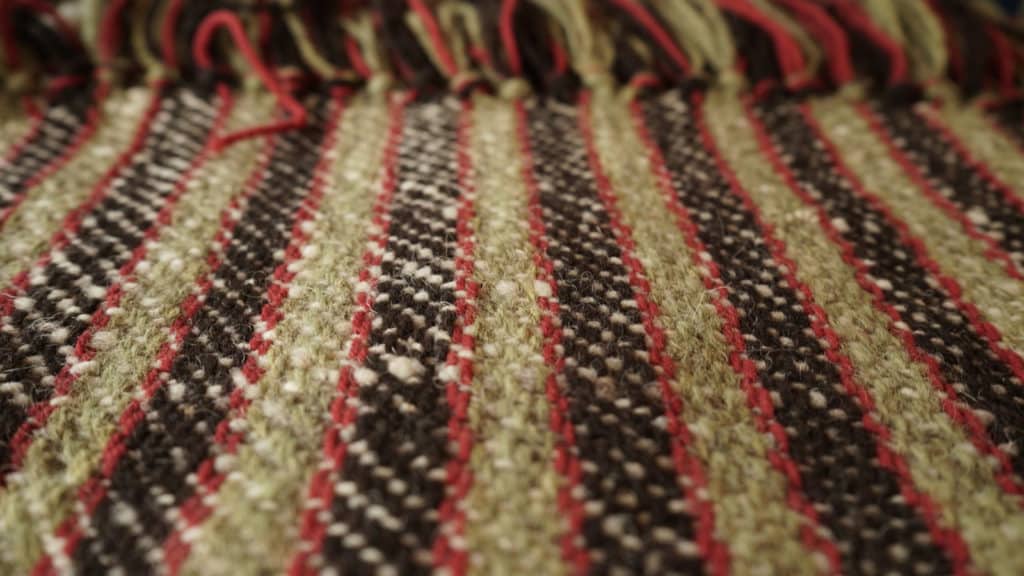
Photo by Stefano Saverioni, Campotosto (AQ), July 27, 2018, Don Nicola Jobbi Study Centre Archive.At the workshopThe art of the loom - Striped fabric made with three heddles, commonly used in Campotosto for mattress covers, light blankets and wheat sacks.
Photo by Stefano Saverioni, Campotosto (AQ), July 27, 2018, Don Nicola Jobbi Study Centre Archive.Traditional fabricThe art of the loom
WATCH THE VIDEO
Weaving
Assunta Perilli weaving at the frame loom.
Campotosto (AQ), July 27, 2018.
Filming by Stefano Saverioni,
Don Nicola Jobbi Study Centre Archive.
Transmission and conservation
Assunta Perilli’s complex search for ancient knowledge has led her from the use of the loom itself to embrace every aspect of the textile arts and the related activities, in a continuous process of discovery that has never stopped and is still ongoing.
While restoring the family loom she acquired specific competences relative to its components, which prompted her to search her local area to restore or find replacements for parts of the machine that were worn-out or no longer working, such as the delicate combs, which she found in Montorio al Vomano (TE) at the workshop of one of the last craftsmen able to make them. Visiting the very few wool carders of Pietracamela (TE) that are still able to work and involving the elderly women in spinning the fibres or rediscovering the traditional decorations on fabrics and clothes stored in the houses, and their diverse functions, allowed her to enliven a transmission of knowledge that had disappeared till then.
One of the most significant elements in this preservation process has been the recovery of flax cultivation through the use of ancient seeds, kept by an elderly woman from Campotosto, Laurina Antonacci, donated to Assunta by her nephew and replanted with the help of weaving experts. It was thus possible to reproduce the processing of the textile fibre of the flax, starting from the cultivation of ancient seeds, that the old country woman had replanted every year although their use in weaving had long been abandoned; an initiative that has also attracted the interest of the University of Cambridge and brought about the insertion of the flax of Campotosto in an international experimental project.
The transmission of this art in Campotosto is thus the result of the efforts of numerous individuals who were able to come together when Assunta began her tireless journey of rediscovery, thanks to the help of the many students who over the years have started weaving by attending the courses she teaches at her workshop or at exhibitions and events she has been invited to. Her studio, called “La fonte della tessitura” (The source of weaving), has therefore become the driving force of a new transmission of the art, in the hope that the laborious research conducted in order to learn its secrets can be passed on to others, a desire that Assunta has clearly and repeatedly expressed.
Recently declared “world ambassador” for the National Park of Gran Sasso and Monti della Laga for the protection of the cultural heritage of the protected area, Assunta Perilli, a qualified archaeologist collaborates with the Faculty of Experimental Archaeology at the University “La Sapienza” of Rome for the development of an archaeological museum project. In recent years she has also started producing new textiles, in synergy with the artisan footwear entrepreneur Alberto Fasciani from the Marche region, for the production of shoes made of flax and hemp. Hers is a work of conservation that goes beyond the woven material and nostalgia for a bygone age, becoming an action of cultural resistance in an area threatened by the loss of points of reference and anchors to its history.
-
 Do you have photos, videos or audio related to this asset?You are welcome to share them with us!Share your knowledge, help us building the inventory! Shall you have direct knowledge and multimedia material about this or other intangible assets, fill the form or contact us!FILL IN THE FORM