Ringing the changes
The bells and bell-ringers of Cesacastina

In Fràttoli di Crognaleto time is marked by the rhythmic and cadenced sound of a chisel. It is the “beat” that accompanies the making of fireplaces and architraves, doorways and window frames, sculptures and objects of daily use. Serafino Zilli has inherited from his father and grandfather the art of chiselling sandstone from the Monti della Laga, a craft once widespread all over the mountain. He spends his days in the outdoor workshop in front of his house: you have to strike the stone more times than there are stars in the sky in order to produce a fireplace.
“For me it is a music that you listen to and you work; they are not strong beats, they are beats of a goldsmith, as a goldsmith would do with his little hammer, the beats are far more than stars, there are so many, many blows, because you need to work around the stone, you need to release this figure, as Michelangelo said …the figure is inside and you need to free it”.
Serafino Zilli, January 5, 2016
It was the spring of 1973 when Serafino Zilli, together with his brother Quinzio, was caught by the then parish priest of Cerqueto Don Nicola Jobbi organizing a small orchestra with the few means at their disposal so they could accompany the work of construction workers building a hotel: they simulated woodwind instruments with their hands and a comb, with expertise that amazed the ethnographer priest and those who have subsequently listened to the unusual recordings.
Such musical inspiration was the sign of an artistic sensitivity inherited in the family, which has made Serafino and Quinzio Zilli very skillful designers and stonecutters, enthusiastic manipulators of materials, musicians and repairers. “We were born with drawing skills, my brother Quinzio and I”, says Serafino; instead they both learned the art of chiseling from their father Alberto, who had also learnt from his family. The passion for drawing accompanied Serafino since childhood; when he went to school as a teenager, he remained awake until late to draw shapes and figures together with his brother. He observed images and works in the books that circulated in the family, which today he preserves jealously, such as a volume that belonged to his grandfather and which was then handed down to his father: Li cinque ordini di architettura (The five orders of architecture), by Giacomo Barozzi da Vignola, in an edition of 1897 which is full of drawings that he continually consults to get more inspiration for decorations in bas-relief, stands, columns, capitals, friezes and ceiling roses.
From his paternal grandfather Amedeo Zilli, progenitor of the family of stonecutters, he also inherited the ancient chisel, which was used in Rome to carve the stone decorations of the Palace of Justice in Piazza Cavour, the so-called “Palazzaccio”, and also in the Vatican, when as a young man he went there to learn the craft of stone carving from Neapolitan sculptors. On returning to Fràttoli Amedeo put what he had learned to good use, carving stone for the construction of houses, religious buildings and decorations. In 1897 he sculpted a votive niche in his town, dedicated to Saint Anthony, out of a single block of stone ; then he created the monumental window of his house, made in the style of the windows of the “Palazzaccio” to remind him of the work done in Rome. In 1931 he was called to rebuild the bell tower of the church in Padula, which he built in blocks of carved stone together with his seven sons, working on the site for about two years.
Serafino’s father and teacher, Alberto Zilli, Amedeo’s direct heir carved many works in the Laga area: numerous fireplaces, the Pavone Fountain in Alvi and the windows of the church in Cesacastina. His son learned the art by observing and experimenting, through a direct apprenticeship.
Serafino Zilli sculpts tirelessly outdoors, according to a tradition that obliged the stonecutters to work under canopies, except in the coldest months, when due to the temperature the stone became too difficult to handle. He makes soup tureens, mortars, architraves, capitals, columns, volutes, cups with geometric, phytomorphic or zoomorphic motifs, with scenes from sacred or ancient history, of which he preserves countless models, templates, drawings and prints, in his own collections or in the books that accompany him daily in his work of continuous documentation and constructive experimentation. He is attracted by engravings and paintings, ancient and Renaissance sculptures, architectural drawings, the shapes of leaves, frames and various decorative styles.
He describes the most frequent processes, like the orange peel effect bush hammering and making grooves with the awl (lu puntarulë). He shows us his chisels (lu scarapillë), of various sizes and types: the diamond shape chisel for removing stone , the three-point chisel for engraving multiple lines of excavation and the fine point chisel for making the so-called capelli (hair) or very thin lines. He has several types of hammer, from the shortest one to a much larger one for heavy operations, and also various sizes of rasps, used for shaping the soft Majella stone, which he occasionally uses to create different types of objects and sculptures with the help of additional carpentry chisels, of a much more delicate quality and more suitable for working with such a soft stone. Instead, the pietra serena sandstone, “eats” the chisel, it consumes it, and to make it effective again it is necessary to have it sharpened by a blacksmith from time to time.
When Serafino Zilli terminates his works, he pours himself a glass of wine and observes them, thinking about how many blows were needed to achieve them. He speaks of them as creatures from which it is finally necessary to separate as they “leave” to go to their various destinations.
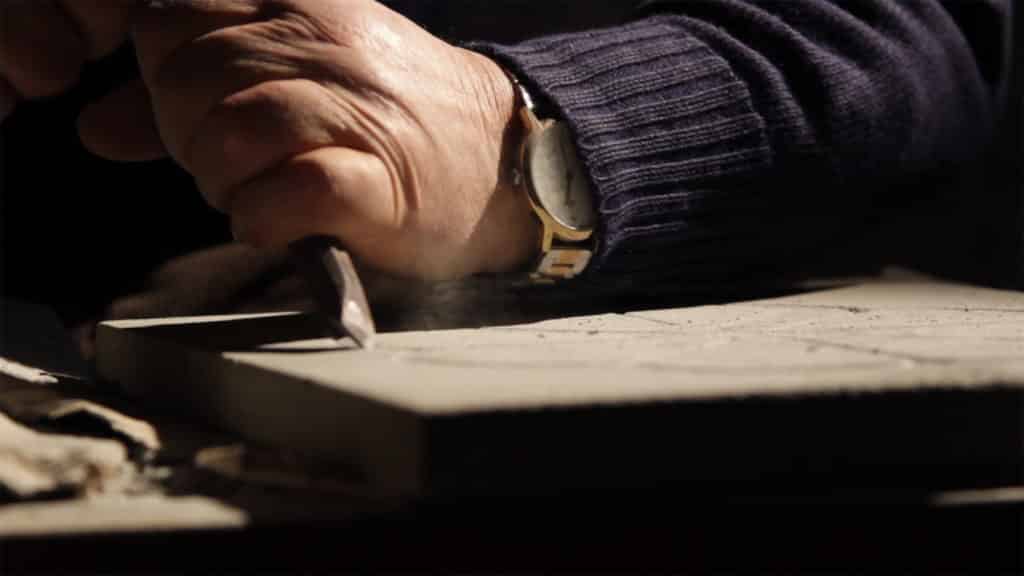


Carrying out the preparatory drawing of a ceiling rose on the stone.
Fràttoli (TE), January 5, 2016.
Footage by Stefano Saverioni,
Don Nicola Jobbi/Bambun Study Centre Archive.
The processing of sandstone in the area of Monti della Laga is now a craft in which very few individuals are engaged, in a professional dimension that is often marginal and complementary to other occupations. The stonecutters, once necessary for the principal activities of local construction, are no longer required if not for the occasional realization of decorative articles aimed at embellishing homes, like carved fireplaces. Together with Serafino Zilli, who represents the older generation, the art of stonecutting is continued by Paris Orsini of Rocca Santa Maria, a descendant, like Serafino, of a family of stone workers and builders.
Over the years Serafino Zilli has participated in numerous initiatives for promoting the craft and the territory organized by various local authorities; among the most significant is the Symposium of Sandstone Sculpture in Tottea, promoted for some years by the Tourist Board of the small village in the Laga mountains, nestled in the rock, which has given life to a unique open air exhibition, in the small squares and streets, filled with the works carried out on-site by sculptors and stone-cutters from all over Italy and other parts of the world..
However, a real course of action for the transmission of Serafino Zilli’s knowledge and skills, which he gained through a long professional and artistic experience, has never actually been initiated, neither within the family nor in a broader context of intergenerational transmission. His brother Quinzio is also an excellent sculptor of stone, but he does not exercise the profession except for making domestic embellishments for decorating his home and those of close relatives.
In 2015 Serafino Zilli was the protagonist of the first short film centered on the sound dimension of the work of the stonecutter, made by Gianfranco Spitilli, while in 2016, on the initiative of and financed by Co.re.com. Abruzzo in the context of a series dedicated to the intangible regional heritage called La memoria lunga (the long memory), a short documentary was made, directed by Stefano Saverioni, bringing together the two stonecutters, Serafino Zilli and Paris Orsini, both witnesses of epochal generational, social and cultural changes in the practice of sandstone sculpture that threaten to lead to its complete extinction. The documentaries have circulated in numerous national and international festivals , such as the Bellaria Film Festival, bringing to the attention of a wide audience the lives of two stonecutters, their competence, and the passion that leads them to think about the stone every day as a material to be shaped first and foremost through the imagination.


The bells and bell-ringers of Cesacastina
The storytelling song in Cesacastina
The Christmas fire in Nerito
© 2018 All rights reserved